


Choosing between design-build and a separate designer and contractor changes who you contract with, who coordinates design with construction, when pricing becomes reliable, and how much involvement you need as the owner.
For a Dubai renovation, the better model depends on project complexity, design maturity, procurement priorities, owner involvement, and team capability. Neither structure is automatically cheaper, faster, or lower risk. The practical question is which structure makes responsibility, design control, pricing, and changes clearer for your project.
InfraNova’s renovation services in Dubai illustrate an integrated route connecting design, approvals coordination, procurement, execution, and handover.
What Is the Design-Build Model?
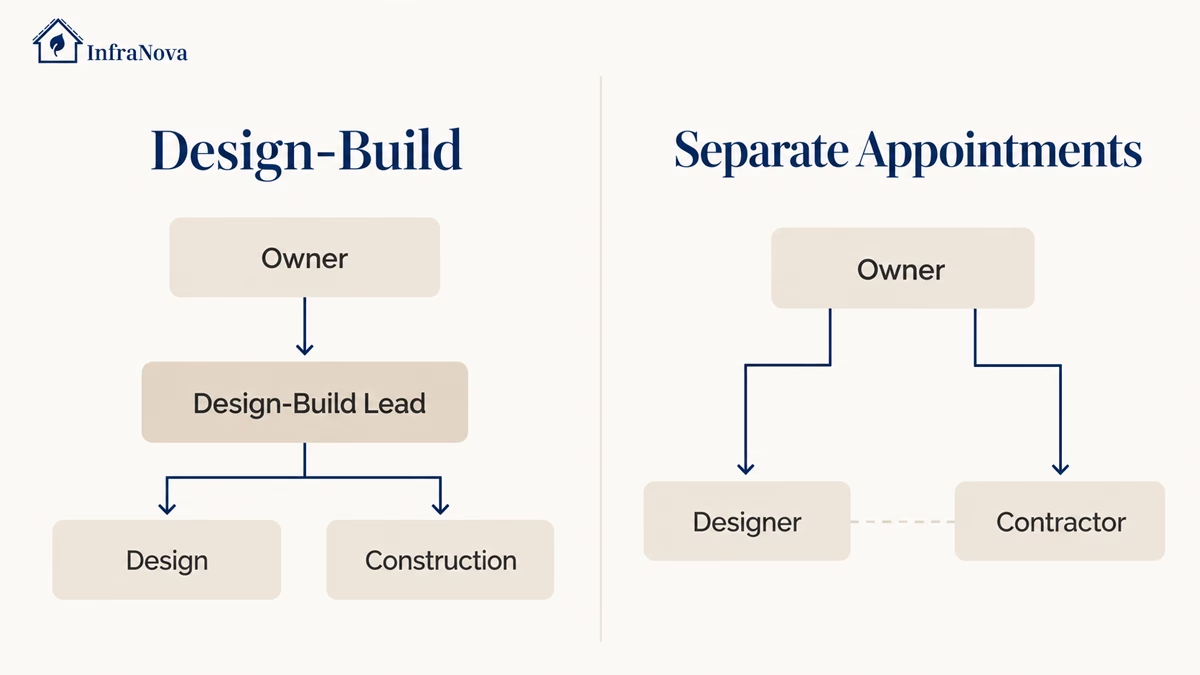
Design-build places design and construction under one primary organization or contractual relationship. The owner appoints one design-build lead instead of separately appointing a designer and then a contractor.
The internal structure can vary: designers, consultants, site teams, and specialist subcontractors may still have separate roles. For the owner, the key point is consolidated responsibility for coordinating design with delivery.
The AIA and AGC describe design-build as a model in which the owner contracts with one entity for both design and construction. That can support earlier buildability and cost input, but it does not remove the need for clear scopes, design approvals, pricing assumptions, exclusions, and change procedures.
What Does Using Separate Designer and Contractor Mean?
With separate appointments, the owner typically appoints an architect or interior designer first. The designer develops the design, specifications, and tender information; contractors then price the work, and the owner appoints a contractor separately.
This design-bid-build structure can preserve design independence and make it easier to ask several contractors to price the same developed package. It can suit owners who want the design substantially resolved before construction procurement.
The trade-off is coordination. When design and construction are held under separate contracts, the owner or project manager usually has a larger role in managing interfaces, revisions, contractor queries, pricing changes, and responsibility gaps.
The Key Differences at a Glance
| Decision Factor | Design-Build | Separate Designer and Contractor | Owner Consideration |
|---|---|---|---|
| Contract structure | One primary design-and-construction relationship | Separate design and construction appointments | How many interfaces do you want to manage? |
| Responsibility | Consolidated through the design-build lead | Divided by professional scope | Are responsibilities and exclusions explicit? |
| Design control | Owner approves design within an integrated team | Designer can remain independently appointed | How important is independent design advocacy? |
| Pricing | Cost input can start while design develops | Construction pricing usually follows a developed tender package | Do you prefer earlier cost input or later like-for-like tendering? |
| Buildability | Contractor input can influence design earlier | Contractor input often increases after tender | Are there significant technical or site constraints? |
| Procurement | Approved packages may be ordered earlier | Usually follows design and contractor appointment | Are long-lead items important? |
| Programme | Design, procurement, and construction may overlap | More sequential design, tender, and build phases | Can decisions be made quickly enough to support overlap? |
| Changes | One lead coordinates design and construction impact | Designer revises; contractor prices execution | Is the variation process documented? |
A strong separate-team project can outperform a weak design-build project, and vice versa. The model matters, but team quality and documentation matter more.
Accountability and Communication
Design-build can simplify communication because one primary party coordinates design and construction. A site issue affecting drawings, cost, sequencing, or MEP coordination can be addressed through one delivery lead rather than first requiring the owner to decide which party owns the problem.
Separate appointments divide professional responsibilities. This can create valuable checks and balances, but it also creates more interfaces. The owner, designer, contractor, and project manager need a clear process for instructions, revisions, approvals, and cost impacts.
| Project Responsibility | Design-Build Lead | Separate-Team Lead | Owner Verification Point |
|---|---|---|---|
| Design development | Design-build team | Designer | Who approves each design stage? |
| Construction feasibility | Integrated team | Contractor / specialists | When is buildability reviewed? |
| Specifications | Integrated design team | Designer | Who approves substitutions? |
| Site coordination | Design-build project team | Contractor with designer input | Who closes coordination issues? |
| Cost of design changes | Coordinated by design-build lead | Contractor prices designer revisions | Is approval required before execution? |
| Authority / building submissions | As defined in scope | Assigned across designer, consultant, contractor, or owner | Who is responsible for each submission? |
| Handover | Coordinated by design-build lead | Contractor plus relevant consultants | Which records must be delivered? |
Design Control and Independent Oversight
Design-build does not automatically mean less owner control. Owners can require concept approval, developed design review, material samples, 3D visuals, technical drawings, and written sign-off before packages move into procurement or construction.
The difference is independence. In design-build, the designer works within the same delivery structure as construction. With separate appointments, the designer can remain directly appointed by the owner to protect design intent, review substitutions, and assess construction against the tender documents.
Choose according to the level of independent design advocacy you need. InfraNova’s interior design services in dubai show the type of design deliverables that should be defined clearly whichever model is used.
Budget Development and Cost Transparency
Neither model guarantees a lower final cost. The important questions are when the price becomes dependable and what it includes. In design-build, construction input can begin while the design develops, helping the team test materials, details, systems, and scope against the working budget. But early pricing based on incomplete information should not be treated as a final construction price.
With separate appointments, the owner can develop a fuller tender package and ask several contractors to price comparable information. This can improve like-for-like comparison, but cost feedback may arrive later, potentially creating redesign if the developed scheme exceeds the target budget.
In both models, transparency depends on scope definition, pricing detail, allowances, exclusions, and variation rules.
Establish a Working Renovation Budget First
A realistic starting range can help you decide how far the design should develop before procurement and where early contractor input may add value.
Buildability and Technical Coordination
Renovations contain existing conditions that can affect the design: MEP routes, structure, drainage, ceiling zones, access limits, material dimensions, and hidden site conditions.
In design-build, construction teams can review these constraints while the design develops. With separate appointments, the designer can still obtain specialist input, but contractor-led buildability review often becomes strongest at tender or after appointment.
Either way, technical coordination should cover service routes, equipment clearances, wet areas, joinery interfaces, lighting, ceilings, material availability, and sequencing—not only the visible design.
Programme and Procurement
Design-build can allow approved design, procurement, and construction packages to overlap. That may help when long-lead materials or custom items need early decisions.
It is not automatically faster. Owner decisions, approvals, access restrictions, material lead times, payment milestones, and technical readiness still control the programme.
Separate appointments usually create a more sequential route: design, tender, contractor appointment, procurement, then construction. This can provide clarity because the construction package is more mature before work starts, but procurement generally begins later.
Dubai requirements also vary by property and jurisdiction. For example, the Dubai Development Authority fit-out permit currently requires, for applicable projects, documents including a contractor appointment letter, building-owner NOC, relevant authority NOCs, and approved/proposed drawings. Confirm the approval route for the specific property rather than assuming the delivery model determines it.
Changes, Variations, and Disputes
Changes need written control in either model. In design-build, one lead can coordinate the design, price, procurement, and programme consequences of a change. The owner should still receive written variation documentation before execution.
With separate appointments, the designer may revise the design and the contractor then prices the execution. This can provide a clear audit trail, but disagreements can arise if one party views an item as a design correction while the other treats it as additional construction scope.
Contracts should define how discrepancies, substitutions, unforeseen conditions, design revisions, and owner-requested changes are approved and recorded.
When Design-Build May Be the Better Fit?
Design-build may suit owners who want consolidated coordination, early buildability or cost input, and fewer interfaces to manage. It can also suit an overseas owner managing a Dubai renovation remotely, provided reporting, design approvals, document control, variation approval, and handover requirements are clear.
It may be a stronger fit when you value:
- one primary point of responsibility;
- early contractor input during design;
- coordinated procurement and site planning; and
- fewer owner-managed interfaces.
The main risk is relying on integration without enough documentation. One team still needs clear scope, review gates, and accountability.
When Separate Appointments May Be the Better Fit?
Separate appointments may suit owners who prioritize independent design oversight, a substantially completed tender package, or competitive contractor tendering against the same information.
It may be a stronger fit when you value:
- direct contractual control over the designer;
- independent design review during construction;
- competitive tendering; and
- clear separation between design authorship and execution.
The main risk is interface management. The owner or project manager needs to control information flow and ensure that design revisions are reflected in contractor pricing and site instructions.
Questions to Ask Before Selecting Either Model
Before appointment, ask how the project will actually be controlled:
- What is included in the scope?
Confirm design stages, technical coordination, procurement, execution, approvals support, snagging, and handover.
- Who is responsible for each deliverable?
Make design, construction, consultant, and owner responsibilities explicit.
- When does pricing become dependable?
Identify remaining allowances, selections, exclusions, and unresolved design.
- How are design approvals recorded?
Define sign-off points before procurement or construction.
- How are substitutions and variations approved?
Require written cost and programme impact.
- Who manages authority, developer, and building requirements?
Confirm the route for the specific property.
- Who reviews quality?
Understand whether reviews are internal, independent, or both.
- What is included at handover?
Define warranties, manuals, approvals, tests, records, keys/access items, and snagging closeout.

How InfraNova’s Integrated Model Works?
InfraNova’s published renovation service connects design, approval coordination, procurement, execution, and handover within one managed workflow.
A published residential example is DIFC Neon Royale, a full renovation of a three-bedroom apartment in Burj Daman, DIFC, Dubai. InfraNova’s project portfolio and published project updates describe a redesigned, more open layout, large-format Italian porcelain tiles, custom carpentry, updated lighting, furniture, smart systems, and carefully selected finishes. These elements illustrate the importance of connecting spatial design, technical selections, procurement, and on-site installation within a coordinated renovation. The public material describes InfraNova’s integrated delivery approach, but it does not by itself establish the project’s precise contractual allocation of responsibility or individual sign-off procedures.
| Project Type | Initial Brief | Delivery Structure | Coordination Challenge | Verified Response | Outcome |
|---|---|---|---|---|---|
| Full three-bedroom apartment renovation in Burj Daman, DIFC | Create a contemporary home for everyday living and social gatherings | Presented in InfraNova’s integrated, in-house renovation portfolio; project-specific contract terms are not publicly verified | Align revised spatial planning with lighting, smart systems, custom joinery, flooring, and furnishings | Published project descriptions identify a more open layout, Italian porcelain tiles, custom carpentry, lighting upgrades, furniture, and selected finishes | Published result: a renovated apartment designed as a cohesive space for daily use and entertaining; no independent cost or schedule result is claimed |
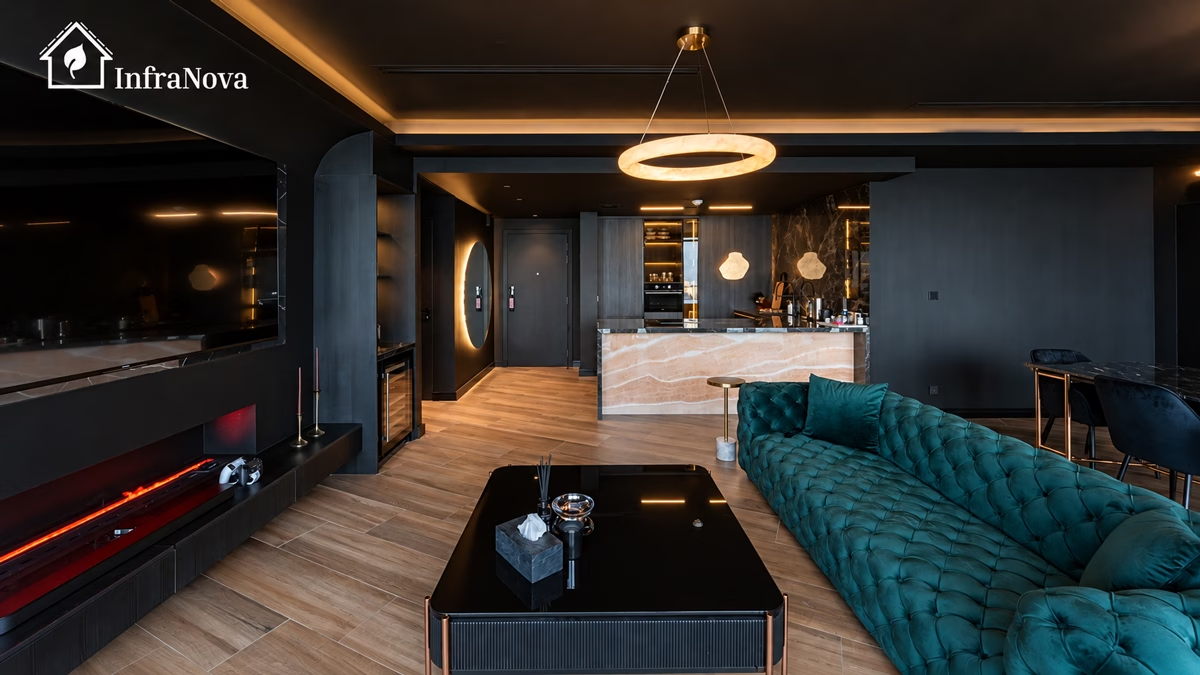
The example shows what integrated delivery should mean in practice: design decisions are connected to technical planning and execution. Owners should still review the scope, pricing basis, approvals, responsibilities, and change procedure for their own project.
Choose the Right Model for Your Project
Use the project circumstances, not the delivery-model label, to make the decision.
| Project Situation | Better-Fit Model | Reason | Risk to Manage |
|---|---|---|---|
| One primary coordination route is a priority | Design-build | Consolidates design and construction responsibility | Define scope and approval gates |
| Owner lives outside Dubai | Often design-build | Fewer interfaces can simplify remote management | Require structured reporting and written approvals |
| Design should be completed before contractor selection | Separate appointments | Supports a mature tender package | Buildability input may arrive later |
| Independent design advocacy is important | Separate appointments | Designer remains separately appointed | Manage designer-contractor interfaces |
| Complex MEP, access, or sequencing | Design-build or early contractor involvement | Earlier construction input can influence design | Do not start with unresolved design |
| Like-for-like competitive tendering is the priority | Separate appointments | Several contractors can price the same package | Tender information must be complete |
| Long-lead procurement matters | Often design-build | Approved packages may move earlier | Early orders reduce flexibility |
Before appointment, confirm:
- Contract structure.
- Design deliverables and review stages.
- Technical coordination responsibilities.
- Pricing stage, allowances, and exclusions.
- Approval and NOC responsibilities.
- Change and variation procedure.
- Quality-review responsibilities.
- Handover deliverables.
If you want earlier contractor input and consolidated coordination, design-build may be the better fit. If you prioritize design independence and competitive tendering against a developed package, separate appointments may be stronger.
Choose a Delivery Structure That Matches Your Renovation
Discuss your scope, design maturity, coordination needs, and preferred level of involvement with InfraNova before committing to a delivery route.
Frequently Asked Questions
What is the difference between design-build and hiring separate teams?
Design-build places design and construction under one primary delivery relationship. Separate appointments give the owner independent contracts with the designer and contractor, usually with design and tendering preceding construction.
Is design-build always cheaper than using a separate designer and contractor?
No. Design-build can bring cost input earlier, while separate appointments can support competitive tendering after the design is developed. Final cost depends on scope, specifications, site conditions, procurement, allowances, and changes.
Does design-build give the owner less control over the design?
Not necessarily. Owners can require staged approvals, samples, visuals, technical reviews, and written sign-off. The key difference is that the designer sits within the integrated delivery structure rather than under a separate owner appointment.
Which model provides clearer project accountability?
Design-build can provide one point of responsibility. Separate appointments divide responsibility by professional scope. Either can be clear if contracts, exclusions, instructions, and change procedures are well documented.
Can several contractors still be compared in a design-build process?
Yes, but competing design-build proposals may differ in solution, scope, team, and price. This is different from asking several contractors to price one completed tender package.
Which delivery model is better for a full villa renovation?
It depends. Design-build may suit owners wanting integrated MEP, procurement, and site coordination. Separate appointments may suit owners prioritizing independent architectural control or competitive contractor tendering.
Is design-build suitable for an owner living outside Dubai?
Yes, provided the arrangement includes structured reporting, remote design approvals, document control, variation approval, progress records, and a clear handover process.
What should be included in a design-build proposal?
It should define scope, design stages, technical coordination, pricing basis, assumptions and exclusions, procurement, approvals, programme, change procedure, quality review, and handover deliverables.